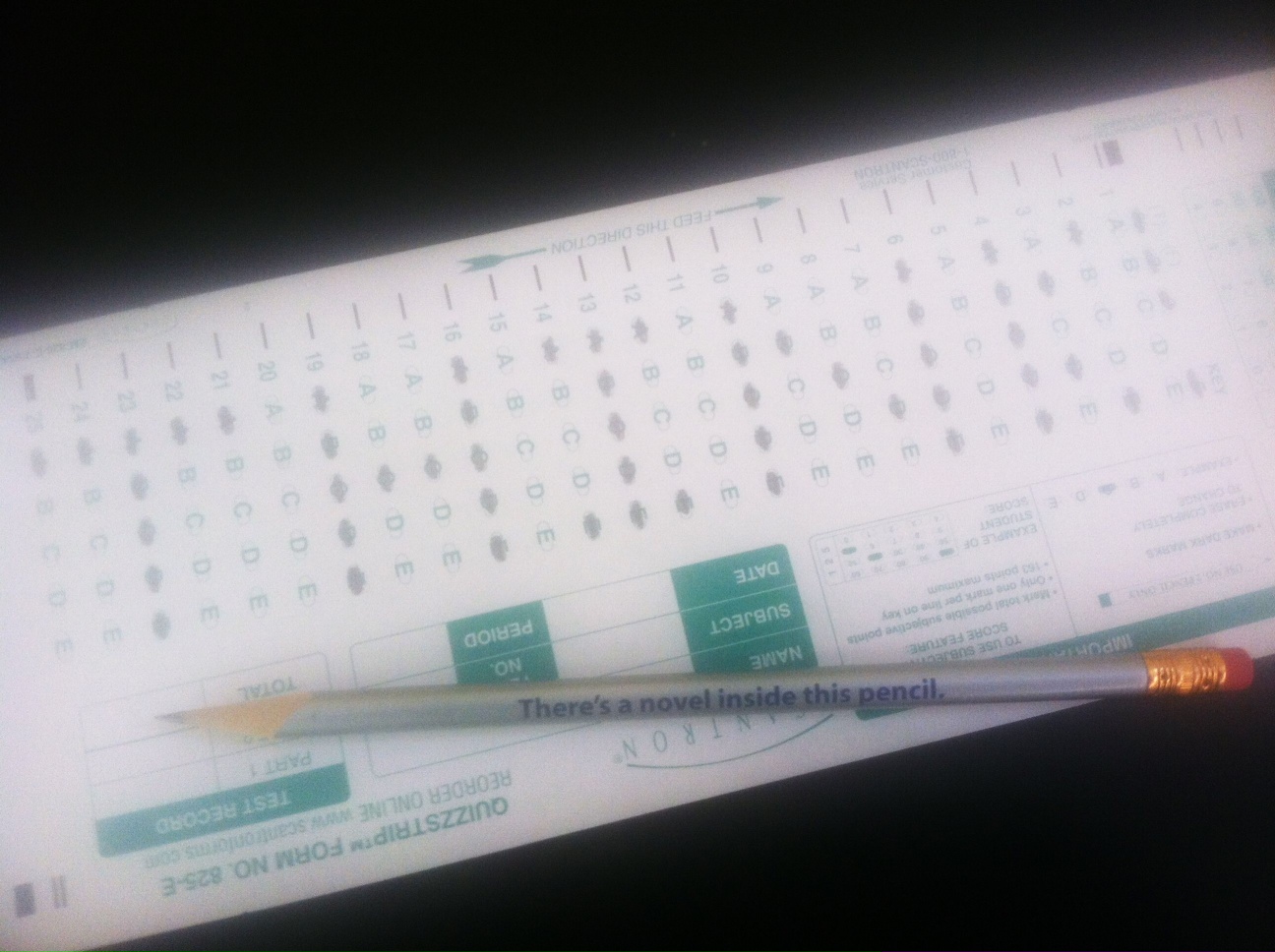
Wednesday, September 4, 2013

Time to art

Beginnings of an early morning effort at City Park

I wanted to be an artist growing up. I waited impatiently in school for art classes, and I can still remember projects from elementary school - the excitement of plying scissors to yellow and red and pink construction paper, letting glue dry on my hands and peeling it off (well, maybe that was less about art, but let's call it part of the process), the smell of big plastic jars of bright poster paint. Outside of school, I was in an art class with several other, much older students that was held in a local woman's garage. There, I was able to experiment with the sorts of supplies that were too expensive to be had in public schools, and the scent of turpentine still takes me back to that space with its unfinished wooden walls and its cluster of easels, shelves of motor oil and mason jars of bolts.

High school was where I realized that I probably wasn't cut out to be a real artist despite the loving care of a wonderful and very encouraging art teacher. I took a few pieces to a juried exhibition for a summer program, and walking down the aisles of art, spread out on a basketball court in Raleigh, I realized that I simply was not inspired. I knew without any sense of regret or sadness that I just wasn't an artist the way that some of these kids were artists. While I'd spend years of my childhood learning, I didn't have that natural thing that inspires remarkable art.

It wasn't a traumatic experience. I accepted it and turned to language arts, my second love, as my chosen path in college, and I wrote a lot of horrible but inspired poetry in college along with some not terrible but not particularly fantastic short stories.

But I never made any art again, not even bad art.

To be honest, I barely noticed. I enjoyed the art that other people created, and that was enough.

And then I had Fain.

I have to think that it was being part of the most natural creative act in the world that re-ignited my early impulse towards making art. Then, as a single mother on a teacher's salary, some of the motivation was a restricted budget. Art was a cheap way to spend quality time with Fain. Art was also a cheap way to make a comfortable, happy home.

And before I knew it, I was happily making things again...as often as a single mother can find time to make things.

So I had my muse in Fain, and now I have Jack, my patron, who encourages me to try everything and take time to sit down and sketch lop-sided houses or learn embroider in wonky, uneven stitches or plant a garden thick with Pride of Barbados and shrimp plants, which really is layering thick, breathing paint on a dark brown canvas.

What I really have to work on now is making the time to make art or my personal imitation of it, which is not a simple task. Not simply because I have a lot of other things to do still (though not nearly as much as I had to do as a single mother, which is a whole other post), but also because a girl has to convince herself that art just for the sake of it is worth making time for. I believe it is when other people do it, but there's a part of me that still feels like it's a frivolous waste of time that could be put to something more pragmatic when I do it.

Monday, August 26, 2013

Growing up


I haven't been writing lately for a very good reason. There's too much to write about. Really. I'm so overwhelmed by changes and adventures and wonders and amazement that I'm not really sure where to even start.

I married an amazing man who has been one of my dearest friends for over a decade. Elvis was our officiant, and the whole ceremony was in haiku. We crashed a corner of Audubon Park early in the morning with Bloody Marys and a bottle of champagne, red Solo cups (because we're classy if nothing else), and a few friends and family members. I yanked my bouquet from beneath an old oak tree, and Jack found a flower in someone's yard. I lost the ring in the tall grass, and Elvis found it. It was an exciting day.

We've been working on this house that Jack has called the Shanty of Solitude for years but that is now anything but solitary with Jack and Fain and me and Scout and Squeaky and Dante all piled into one bed or another playing video games or watching Mr. Bean. But it's still a bit of a shanty, a little forlorn and in need of lots of TLC. We've been shifting possessions from one room to another trying to make room for one another and room to work. Room for cats to dodge dogs and vice versa. Room for bicycles and boxes of stuff that may or may not be junk depending on who you ask.

Jack's my own personal patron of the arts, encouraging me to join the Master Gardeners program, train with the docent program at NOMA, paint or embroider, plant things, take a part time job as an after school enrichment teacher at Akili Academy across town, so there's so much to keep me busy.

But there's something really special that I want to write about, even special amongst a whole world full of special new things, and that's dropping Fain off for his first day of school. Yes, he's in the fourth grade, and so dropping him off perhaps should be old hat, but I've never had to drop him off on his first day. His grandma took him to school during Kindergarten and first grade because I had to be at work early, and during second and third grade, we were at the same school, so I never really had to leave him.

It was painful. Agonizing. I felt like a horrible mother standing there at the tall, chain link fence watching him make his way to class all alone. And it wasn't all in my head. He's gotten used to having good, ol' mom around all the time, so he was wary of leaving me behind, and we both did our fair share of crying about it. Wednesday, Thursday, and Friday.

But finally we started running late. It only takes a few days. So I didn't have time to walk with him from the parked car. I had to let him hop out and run to the gate alone. And something about that, watching him brave the sidewalk alone, walk that block by himself, filled my heart up with pride and excitement for him. It's good that he's becoming this independent person. It makes me look at him differently, as a really cool separate person as opposed to a really cool extension of myself.

I have an awesome kid, and I'm glad that I get to let him go a little even though I still get a weepy about it. He's like my own personal Mars Rover, exploring strange new worlds and reporting back to me over ice cream in the afternoon.

Thursday, July 18, 2013

Not so different

I'm finally in New Orleans for good. It's a completely different experience than I had the first time I arrived when I was much younger. In some ways.

For one thing, I am older. That translates to: I'm more of a chicken. Having a kid made me more cautious than I was when I was in my twenties. That's normal. I worry more. Panic more. I am not the care-free girl I used to be. I've spent a few afternoons in tears feeling completely overwhelmed and out of place.

On the other hand, that girl still has a pretty firm grip on the reins or I wouldn't be here at all. A year ago, I would've laughed if someone had told me I'd be marrying my old buddy Jack and packing everything up to move to New Orleans. In fact, I'm pretty sure I told Jack he could forget it. I wasn't going anywhere. I was perfectly happy where I was. So there.

But he's so darn cute.

Enough gushing. I guess the only way I'm really different after all is that I'm older and more cautious, but clearly not that much more cautious.

And maybe for all that the experience isn't so different either. I still feel giddy when I'm walking in the shade of live oaks and peeking into walled in gardens. I still salivate over the smells of percolating coffee and French bread fresh out of a bakery oven and roast beef marinating in garlic...mmmmm. I still get excited when I hear someone walking down the street blowing into a horn or strumming a guitar or setting up a keyboard and sitting down to play a tune. I still feel inspired to get out paint brushes and paints when I pass all the art on the streets.

It just took a week or so to start to feel at home again. To get through that spell that felt like the current reality may or may not be actually real.


Thursday, May 16, 2013

Love and Video Games

It's that time of year again. Spring is in the air, and sixth graders are turning into seventh graders, and then it is that their thoughts turn to thoughts of love. It also happens to be the time of year when I teach the elements of poetry.

Each year, I force (er, challenge) my sixth graders to participate in a contest wherein they must come up with the most original, never-before-used simile for love. The project begins with moans and groans, but in general the kids are completely immersed in the task within a few minutes, and I've had some truly glorious similes in the past.

My personal favorite remains:


That's a sixth grader for you.

They have to provide ten supporting arguments for how the two things are similar, and I've learned a good deal about love by reading some of their arguments. (It also makes me speculate, sometimes, on the nature of their parents' love lives.)

I always provide my own example, which is video games, because, well, video games are cool and so is love, and I know some kid would choose it if I didn't, and frankly, it's not original because Lana Del Rey's already used it.

So here it is, and it may cause you to speculate on my own love life, but nonetheless:
  1. In both love and video games, there are rules, but you generally have to play to figure out what they are and sometimes you never do.
  2. In either case, you can win even if you don't know the rules, and you can lose even if you know them very well.
  3. Whether playing video games or playing the field, you don't have to follow the rules to play, but if you break the rules too often, you might run out of people to play with.
  4. Some people become so obsessed with video games, it's all they think about. I don't think I need to explain that: stalker.  
  5. If you don't go outside and get a breath of fresh air every once in a while, both can give you a headache.   
  6. Video games have epic wins and epic fails. Love can be pretty epic, too. 
  7. You can buy video games new or used, they come in all kinds of conditions, but you can play them in most any condition (unless they've been used so roughly that they don't work anymore). First love is new, but usually people have other loves that follow that aren't new but still work out anyway. And some people have been hurt so badly that they don't know how to love anymore. 
  8. There's always another challenge in video games (but you keep playing because it's worth it when you win). Ditto, love. 
  9. Video games are built by other people before the player can use them, and those builders were influenced by video games that they've played. Of all the things that have changed about humans throughout our history, love has tended to stay pretty much the same; we've learned it by watching those who've loved before us. 
  10. There are many different types of video games: some are for thinkers, some are for adventurers, some are for fighters, but the best probably have many different facets. The greatest loves, the ones that you come back to over and over, are those that challenge and engage all of the parts of who you are.

Sunday, May 12, 2013

Batman at the yard sale.

Last weekend I had a yard sale.

It took over a week to prepare for it. To rummage through all the stuff I've accumulated over the last seven years and decide what's worth taking and what's ok to give up.

Throughout the process, I marveled at my lack of nostalgia. I ruthlessly threw stuff into the reject pile, feeling a sense of liberation from things, which I am, in general, a big fan of.

However, on the day of the yard sale, as people pawed at what was once mine, deciding whether it might have any value to them, I did get a little heartsick.

Not over the dishes that I've served friends and neighbors on for years or over the gaudy jewelry that I've impressed countless third graders with, but over Fain's stupid toys that I've been tripping over and cursing for years. The Batcave with its real moving elevator and garage for the Batmobile. The dozen Batman action figures, cars, villains, weapons, the list goes on.


Fain didn't have any remorse over selling them to the highest bidder. In fact, he told me I could sell everything in his room except for his computer and a few of his baby toys that he wanted to keep for sentimental purposes. (I didn't sell everything, but he did get a big haul that day.)

But as I watched child after child ooh and ahh over the Batcave (and corresponding Joker toy factory/lair), I got a twist in my stomach. I wanted to yank them all back and shove them back in his room where I would, no doubt, spend the last month of our stay in this little house tripping over them and cursing them, just like in the old days.


I don't know what it is. It just got to me.

Then a young woman came and asked about the Batman assembly gathered on the tablecloth under the tree in my front yard. She told me her daughter loves Batman, and her birthday was coming up, and the young mother was practically buzzing with excitement over the find. She asked the price, and after a moment of hesitation, I sold it cheap...cave, toy factory, heroes, villains, the whole lot...because ultimately I liked the idea that there's a little girl who loves Batman. I can relate to that.

And, honestly, she'll probably get a lot more satisfaction playing with it than I'd get cursing it.


Saturday, May 11, 2013

This is where I change topics.

So this is where the posts start to shift from my obsessive yammering on about education to an obsessive yammering on about THE MOVE. (I considered referring to this integral time in my life as THE CHANGE, but since that's also an old-fashioned euphemism for menopause, which I'm not undergoing currently, I felt I should stick with the more specific description.) I'm referring to the move from a small town in rural North Carolina to New Orleans. From being a single mother for seven years to being a married lady.


The move is only a month away. The months from Thanksgiving to Spring Break - those were the months between visits with Jack - seemed to drag by. But the months from Spring Break until June 15th are flying - Back-to-the-Future-burning-tire-marks-in-the-road-flying. They're going so fast that I hardly have time to be nervous. So fast that I really don't even have time to think about it anymore. I'm on auto-pilot...


Except for a few moments every now and then. Like watching a BBC detective drama at night in the quiet of the house after I've locked the child and the cats away, when it occurred to me that all the things that have become familiar to me...my little house, my little routines...are about to change drastically. (But then someone else was murdered in Badger's Drift, so my musings were cut short. Thank you, BBC.)


But wow. I mean. Big change, right? So much change that I don't even think my brain can process it.


So I'm going to shift right now into using-composition-to-attempt-to-process-change-mode.

Thursday, April 25, 2013

Lucky Mother


I read an article in The Atlantic recently called I Refuse to be a Grown-up that described one woman's refusal to be a grown-up-stick-in-the-mud. She equates a liberal, exciting, fun, youthful life with a life unencumbered by the attachments that drag a person into the mire of adulthood, namely marriage and parenting.

I totally get where she's coming from. I used to feel the same way. I vowed I'd never get married and have kids because I didn't want to grow up. Vast stretches of my twenties were spent daydreaming about trips that I never took, adventures that I never had, novels that I never wrote. I was completely free and unfettered, and yet I never did anything with that freedom. 

Conversely, Austin Leon, author of Steal Like an Artist, wrote a post on his blog about how having a child affected his creativity. He writes about a mother who tells him (before his son is born) that he clearly didn't have children because, presumably, people with children don't have the time or energy to be creative. After his child is born, he has to make adjustments, but he vows never to use his child as an excuse to fail at "The Thing" that he needed to do.

I like that.

I'm 38. Just turned 38 yesterday. I'm glad I'm 38. I don't have a single regret about it. It's just a number after all. I don't feel like I'm a different person than I was at 28, even though I know I am. I'm not less fun. In fact, I personally think I'm way more fun than I was then. True, I don't spend every night dancing on tables in bars (and I didn't spend every night dancing on tables in my twenties, thank you very much), but in retrospect, dancing on tables is only fun the first ten times you do it. After that, it just becomes blasé.

I'm 38 and I have one of those pesky little things called a kid (dozens of them if you count my students), but I'm hardly a grown up by any conventional standards, and it's actually age and the kid(s) that have slowed my descent into the stereotypical drudgery of adulthood. I'm able to sing Christmas songs in July loudly in crowded parking lots now without having had a drop of eggnog, and it's because of my kid. What better way to embarrass him? I can spend hours playing video games or watching cartoons, and I can discuss the relative merits of Ben 10 over Generator X with any fourth grader. I start dinner with ice cream and breakfast with cake (not every time), and the perfect meal is still hot dogs and mac n cheese. I wear skirts that look like tutus to my job, and I have the approval of third graders to credit for that.

I'm sure there are parents who got gray hairs over their kids, who gave up on childhood dreams to care for their kids, and I'm sure that there are old people who still look young and dance on tables because they didn't have kids. I needed the kid though. The kid was my howling, spastic, ever-chattering muse. 

I didn't finish a novel until I had my son, and I started and finished it in a month of naps when he was just over a year old. I didn't start making art again until he was old enough to tell me he wanted a pirate ship, and then that experience of making one out of old cardboard boxes and a legless Barbie doll reminded me of how amazing it is to create something just for the fun of it. I've been on more road trips and had more dumb but interesting ideas since I had him. In fact, it's the very thing that some people equate with aging - the responsibility of raising a child - that has really freed me from the whole aging process. I get to be a kid again with him.

Never in my life have I felt younger than I do now. Not that sort of young that I felt in my teens and twenties when I had to be more cynical and apathetic and stubborn than everyone around me, but the kind of young that I see in my kids, able to enjoy things that don't cost money or give me a hang over, able to imagine adventures and then make them happen, able to have silly, un-self-conscious fun.


Wednesday, April 17, 2013

Three cheers for adequacy.

Photo by Terrapin Flyer
Years ago I sat in a staff meeting at a school which shall remain nameless, but which, I feel certain, was very similar to hundreds of other American schools, and I was struck by the excitement over achieving the greatest goal imaginable in public schools: making adequate yearly progress.

Yay. We're adequate. 

Since when did being adequate become something to strive for?

Yay. I'm good enough. Not great, really, but y'know, I'll do as long as there's no one more than adequate around.

For all the lip service given to 21st century skills in schools: collaboration, communication, creativity, innovation, problem-solving, critical thinking in addition to the old stand-bys, the educational system itself is not set up to encourage the mastery of those skills. It's not set up to achieve anything greater than adequacy. Standardized tests, the be all and end all of the educational system, as a general rule, don't necessitate any of the above skills. Some of the skills, in fact, are completely contrary to standardized tests.

Creativity and innovation, for instance, both require a learner to consider several possibilities that have never been considered before. That's the very essence of these skills: generating new possibilities. Problem-solving, likewise, requires the thinker to consider multiple ways to tackle difficult situations, acknowledging that there are several acceptable solutions to most problems, and that the best solution can vary from one circumstance to the next.

Such is not the case with standardized tests whose stems are written as such: Choose the best answer. (The best is generally italicized to draw attention to it.) Of course, best implies that there is more than one answer that could be correct, but only one is best. That best gives the illusion of choice, the illusion of problem-solving and critical thinking. Regardless of the phrasing, however, what the test-makers mean by best is simply...what your teacher would tell you...what you memorized (and will promptly forget after the test). 

The system, at times covertly and at other times aggressively, throws up obstacles to the very skills that are needed in the modern era. Efforts to turn around failing schools with innovative curriculum like the Quest Schools and the Turnaround Arts Initiative - programs that truly, unapologetically embrace the 21st century notion that our students need to be more than automatons, that they need to be independent, well-rounded thinkers - are thwarted by testing paranoia. Tests that don't even begin to measure the skills necessary to thrive in the world keep schools and students as well as teachers from achieving anything beyond adequacy by intimidating them, frustrating any attempts at positive transformation.

Until our educational policy-makers become more creative and innovative, until they communicate and collaborate with teachers and students to discover what is really needed to make classes places of authentic learning, until they recognize the problems in the traditional modes of instruction and think critically about how to solve those problems - in short, until our policy-makers become greater than adequate - we certainly can't expect much more from our schools.

Saturday, April 13, 2013

I: music for a character in a dark place


Because (despite my son's assurance that our house is "quiet, too quiet") my house is full of the sounds of Minecraft mood music, cats knocking porcelain things from high shelves, imaginary light saber battles, etc., I find that I often have to plug up my ears with music that will inspire writing rather than interfere with it. In a perfect world, I'd write in perfect silence, but as it is, I find one song that helps me to picture a scene or feel a mood, and I play it over and over until it becomes a suggestive silence of its own.

Andrew Byrd is perfect for that sort of thing, and his song I was a go to for me while working on sync in November. I was the song that helped me to experience my protagonist's sense of isolation and fear in his most trying moments.

In this scene, Charlie's been dropped into the House of Darkness, the Sumerian afterlife:

If Charlie had feared the consequences of such a long fall – he could not see a bottom to the pit – his fears were soon replaced with fears of a different sort. Around him, he heard the rustle of wings flapping against the blackness, and he felt a presence nearby that he couldn't see. In the next moment, his arms were seized by what felt like talons, biting into his flesh. Something large had captured him and was pulling him through the air, in what direction Charlie couldn't tell.

At some distance, Charlie could see a faint flickering of reddish hued lights, and a shiver went through him. He was approaching the House of Darkness. His eyes had somewhat adjusted to the gloom, and the trickle of light afforded him a view of the creature that had captured him. He looked up and saw that he was in the claws of a beast with the body of a lion and the filthy wings of some giant bird. The face, though, brought a cold chill to Charlie’s heart. It was the face of a man with glowing eyes and the sharp teeth of a vampire. The creature was intent on whatever path it was on and ignored Charlie, and Charlie was glad of it.

The lights of the House of Darkness did not grow brighter as they neared, but they did grow. As the assembly of the gods had been built of a white marble that seemed to stretch in all directions, the House of Darkness must have been built of infinitely dark matter. Though Charlie sensed a structure, it was invisible in the darkness. He felt the floor when the creature dropped him, but he couldn't see it, and so he seemed to walk through nothingness, and his body jerked repeatedly, instinctively, to catch him from falling.

Amber flames flickered here and there, and Charlie, drawing near to one, saw that there were souls or demons, he wasn’t sure which, trapped in these, gnashing their teeth at him when he came too close. He backed away towards what felt like the center of the space and continued walking through the great room of the house. He wasn’t sure where he was going, but he continued moving forward.

He wasn’t alone in the House of Darkness. He heard moans and whimpers, whispers and groans around him, and when he strained his eyes against the darkness, he vaguely saw the shapes of men and women who were covered in matted, gray feathers, some sitting, some lying prone, some pulling up clumps of dirt and shoving it towards their mouths ravenously, some scurrying about carrying baskets and earthenware bowls in the pitch blackness. He could make out hills and mountains rising in the murk, and upon close inspection, he saw that these were built from the relics of the inhabitants of the House of Darkness. One mountain was made entirely of crowns: gold, silver, platinum, tarnished, encrusted with jewels that did not sparkle or glitter in the darkness of the underworld, whose royal lights had been dimmed. Here, all men were the same, thought Charlie. No wonder Gilgamesh went in search of immortality.

Ahead, Charlie saw a conflagration of the amber orbs that cast just enough dim light to allow him to make out the rising of a great throne.

“This must be the place,” he said aloud, just to hear his own voice. In the utter darkness, he had begun to get the sense that somehow he didn’t exist. He felt bodiless, and therefore voiceless, and he wanted to reassure himself that such was not the case. It was an entirely different sensation than what he'd felt on the mountaintop. Then, that bodilessness had made him feel a part of all things, now it made him feel a part of no thing.

He drew near to the throne, which was constructed of an array of bones faintly glimmering with a golden hue under the orbs, and he could see the figure of a woman seated upon it. She had wings that grew from her back, enormous and black and widespread like a vulture sunning itself in the early morning. She wore a crown of gold-tinted bones tangled in her mass of black hair, and her feet were the feet of a great bird with long, pointed talons. Sitting at her feet, her legs crossed, was another woman who held a tablet of gleaming black stone and read from it to the Queen of the Netherworld.

The two raised their heads in unison when they saw Charlie approach, examining him the way that he had seen his mother examine cuts of meat at the grocery store.

Thursday, April 11, 2013

Why it's better to be worser


Years ago, I had the extraordinary good fortune to participate in one of NCCAT's enrichment seminars. It was awesome, and if I could ever persuade any North Carolina teacher to do anything, it would be DO THIS!!! 

The seminars are intended to reinvigorate teachers with a healthy dose of fun learning...you may be noticing a theme in my writing. Sometimes the seminars are specifically related to pedagogy. This season, for example, one offering is "Catching Up With Your Students: Navigating Technology for 21st Century Classrooms." Many of the seminars though are strictly pleasure-learning. Science aficionados might participate in "Climbing the Double Helix: Is DNA Destiny?" Teacher-writers might try out "Writing from Sound to Sea: Awakening Creativity by the Shore."

When I went, I participated in a seminar on Nature Writing and Watercolor Painting. The first part was a breeze for me. I love nature, and I love writing, so naturally, writing about nature was something that I'd already practiced on my own for years. When I first began the seminar, I wasn't too stressed about using watercolors either. After all, I'd taken art courses in high school, and I wasn't too bad at it. I like to consider myself a fairly artistic sort.

I remember that first session when the artist who was leading the workshop quickly dashed off a beautiful mountain landscape complete with fallen logs and winging crows. It looked simple enough, and I went back to my little table eager to get started. It's just a line here and a couple of splotches there, after all. Nothing too challenging.

After only a few moments I realized that my teacher had made the act look much simpler than it really was, and I could feel my frustration mounting as I fumbled with my brush, clumsily smearing black tree trunks and blobs of orange leaves that looked at best like a kinder-gardener's nightmare. I walked around the classroom to see how my peers were doing, envious of those who had quickly picked up the skill and reassured by the rest of the crew who were as sorry as I was.

By the end of the week, I was a little better. A little. But I'd learned a really valuable lesson that I took back with me to school. Sometimes teachers need to be worser to be better.

What I mean is this: sometimes, because we're so dang good at what we do, we forget that it's not easy for everybody else. We don't always respect the learning curves of our students. I've been guilty of it when teaching writing and technology. I've found myself growing impatient and thinking, "Gah! It's so easy! Just do xyz..."

When we get to that point in our careers, it's important to do something that we're not good at. This is why I've said before and will (I hope) continue to say: A teacher who refuses to learn should retire. Because if we push our students to stretch themselves, to risk failure, then we have to remember what it's like to stretch, to risk, and yes, to fail. If we stay in our comfort zones, it's easy to get so comfortable that we forget the anxiety of learning something new. 

A good teacher should be a dilettante, not just an expert in one field. Experts forget what it's like to struggle with understanding, they forget that they once had a learning curve. A good teacher should be really terrible at a lot of things and she should strive to improve in the face of frustration and embarrassment so that she is always capable of empathizing with her students.

Wednesday, April 10, 2013

Just say no to fun-suckers

Nicole Dodson, Dakota Jerome Solbakken and Nadine Clements, students at Quest to Learn, a New York City public school, play a game they designed.


Institutionalized prejudice against fun in the classroom works against students, teachers, and societal progress as a whole. A crippling bias in favor of traditional pedagogy, a stultifying notion that because classrooms were not fun in the past, they needn't be fun today has contributed not only to the low graduation rate in American schools but also to the low morale of educators themselves. 

Almost half of the students interviewed for the Bill and Melinda Gates Foundation study on high school dropouts claimed they dropped out because classes weren't interesting. According to an NEA report on teacher attrition, of the 46 percent of teachers who leave the profession after only five years, 56 percent cite job dissatisfaction as their reason for leaving. That dissatisfaction is directly tied to high-stakes testing, confused administration, and lack of support and respect. In short, teaching just ain't fun anymore.

Despite the fact that fun could be the savior of education, it's under fire from all sides. Innovative school ventures such as the Quest to Learn school in New York, create stimulating, exciting, rewarding experiences for students and teachers alike. Yet the same parents who fight to have students enrolled in the school, fight equally hard to ensure that the learning becomes increasingly more traditional so that students are prepared for standardized tests (which, if I haven't mentioned this before, prepare students for absolutely nothing in the real world). Meaning, even parents who want their kids involved in more creative, relevant learning, are too afraid of standardized tests to fully support innovation.

Likewise teachers, who would benefit from fun more than anyone aside from students, are often biased in favor of more traditional pedagogy, frowning at fun with the dour affect of a Victorian schoolmarm. They say things like: Fun might mean fun for kids, but it means work for teachers. Kids who are having fun in a classroom simply aren't learning. And, my personal favorite, fun classrooms don't prepare students for the real world.

True confession time. I have told kids, "Kids, this isn't Disneyworld. It's school. It's not supposed to be fun. You're supposed to learn." I admit it. I'm not proud. But in my defense, usually those non-exhortations were direct results of exhaustion from the hundred miserable and utterly meaningless tasks assigned by supervisors appointed at the government level who have never set foot in a classroom for more than five minutes, who have done everything in their power to suck the joy out of teaching and learning.

There have been times when I felt like I was smuggling fun into my classroom, looking over my shoulder to make sure no one was watching, as if that would somehow undermine my authority and credibility as a teacher. And I learned early in my career that as a general rule, fun as pedagogy should not be discussed openly as the very notion pisses a lot of people off, and it doesn't take long for the fun-suckers to start giving you the stink-eye if you're a proponent of such blackguard practices.

But here's what I've discovered over my years of teaching, short though they may be.

Fun is not more work for a teacher. Coming up with fun lesson plans is exactly the same amount of work as coming up with boring lesson plans. Implementing fun lessons is easier than implementing boring lessons. Kids enjoy it, and people commit to things they enjoy. When my kids are having fun while they're learning, they learn more and they don't fight me over it. I've had classes so fun that kids didn't even want to stop learning, and that's a score in my books.

Fun does not void learning. I'm much likelier to stick to something that I'm enjoying. I don't mind practicing something that's fun. And activities that are novel and interesting stick in my mind longer than those that are dull to the point of brain freeze. Innovative educational practices such as Smallab, or "situated multimedia art learning lab," that allow students to learn in exciting, virtual environments, interacting with material rather than having material thrown at them via lecture, have proven already to bear great promise. In a small 2009 study, at-risk ninth graders in earth sciences scored "consistently and significantly higher on content-area tests" when they had participated in Smallab exercises than those who had been subjected solely to more traditional teaching methods.

Finally, there's no reason why the real world, the world of adulthood, has to be anything less than fun. In fact, we are uniquely positioned in history to create exactly the sort of real world that we desire. There are more start-up businesses today than ever before in American history, and that means that people are crafting careers for themselves, and I can almost guarantee that entrepreneurs are not designing futures of arduous anxiety. We're building the careers that we want to have, the lives that we want to lead. Schools should most definitely be preparing students for that future.

Wednesday, April 3, 2013

The two choices you get in life


Even though I rail against an educational system that depicts life as a series of multiple choice problems with very limited actual choices, in reality, there are always only two choices in life at any given moment - continue on as I am or choose something different. Either way - whether I choose the security of where I am or the uncertainty of where I might be - there are risks, I'm just ignoring them when I make one choice and acknowledging them when I make the other.

This seems to be a running theme for me lately, and for good reason. I'm about to change my whole life as well as my child's - getting married, moving to a new place, enrolling in a new school, finding a new job. While my status quo has included all the struggles that any single, working mother faces, the struggles have been predictable. Though I've missed the variety of New Orleans, the culture and the opportunities, I've grown accustomed to the quiet nights of a small town. I've had moments of loneliness, but I've gotten used to being alone.

Despite inherent monkey wrenches in the machine, I've carved out a safe, cozy little life, and now I'm leaving it behind in favor of an exciting unknown. There's a certain amount of trepidation in sacrificing the comfort of a dull familiarity, an often worrisome familiarity, even in favor of a promising unknown.

There was a moment, months ago, when I had to weigh those two choices - to stay or to go, to risk or to retreat - and make a decision. It was nerve-racking trying to imagine every possible scenario that might result from either choice, and of course, it's impossible. There was no doubt in my mind that I loved my fiance Jack and that we'd be happy, but it meant changing everything my kid and I know in one swift motion. Everything. A very patient friend, after months of listening to me worry over possible futures, finally said, "You don't get to know what will happen. You just have to decide."

Jack has said the same thing about my writing. I've always written just for myself because I enjoy it. I've written a novel a year since Fain was a baby, but they were always just an escape for me, a free vacation. Recently, as I've considered publishing, I've been gripped by fear. Writing for myself is safe; writing for publication is a risk. Jack consoled me in a moment of neurotic crisis by telling me that if I tried and failed, nothing would change anyway, so I may as well get on with it. (Poor man, he's taken the great risk of marrying a neurotic lunatic.)

If I don't choose the risk of the unknown - whether it's marrying, moving, or writing - then I may as well quit teaching. If I won't take risks myself, even if it's scary as hell, I've forfeited the right to ask my kids to take risks.

Tuesday, April 2, 2013

A sense of limitless possibilities


I've spent most of the day walking around New Orleans, re-exploring. Although North Carolina has been good to me during the past seven years, I did miss the sense of unexpected possibilities that I always had in New Orleans.

After walking around my small town in North Carolina a few times, I had memorized it. Once I became that familiar with it, I started to forget what it was like to be surprised and excited by constant newness. I think in a way, it also limited my sense of my own possibilities. Walking around today, peeking down streets, into shops, I got that sensation of expansiveness that I remembered from my time here before.

I remember my very first night in New Orleans. I was twenty four, and I arrived at the hostel where I'd managed to get a job just as the daytime sky was fading into a gray blue evening. I remember standing outside the old house on Prytania breathing in the air. It had that thick, sweet nighttime in the South smell that I'd never noticed anywhere else before. I recognize it in other places now, but it always makes me feel as if I'm standing back in New Orleans on that first night. I imagine it's the smell of old oaks and palms and jasmine breathing out a sigh of  relief with the setting of the sun.

I was overwhelmed with excitement back then. I'd always wanted to visit the city, but I never imagined that I might live there. I'd grown up in a small town with a strong sense of expectation and duty. Striking out into the world alone hadn't been among my plans, and it was just a strange caprice that prompted me to pack everything up and leave what wouldn't be packed up behind. Standing there then, I was still surprised by what I'd done. I was still a little dizzy with a sense of the unreality of it.

That was probably what made New Orleans so special to me. My snap decision to break out of the limits that I imagined for myself seemed bound up with the city so that I attributed to it a surreal magical quality that continues to color my view of it. I get the same thrill now when I strike out on a long walk here that I got those fourteen years ago. That I'm on an adventure. That anything is possible. That I might still surprise even myself.

Thursday, March 28, 2013

The infinite possibilities of seven billion brains with one hundred billion neurons a piece


One of the hardest parts of teaching writing is giving feedback. It can take days to accomplish this feat. By the time the stories my sixth graders write are completed and ready to be reviewed, I've already read them several times in order to give encouragement or advice along the way, but I still struggle with feedback. When they compose, my kids have to sit and think, pull ideas from their own minds, commit to them, stand behind them, none of which are easy tasks, even for an old woman like myself. Consequently, when I judge my kids' writing, I know that I'm judging my kids. I want to be honest with them about what works and what doesn't, but I want to be gently honest. I want to be the sort of honest that prods them to improve, not the sort of honest that prompts them to give up on writing altogether. 

Because even if the writing is terrible (and sometimes it's beyond terrible and well into the realm of painful to read), it meant something to my kids. Even if the kid in question protested throughout the process, declaring that he wasn't even really trying, it meant something. And even if the kid defiantly ignores my counsel in favor of what he thinks is the best way to tell the story, I want to support that because I want my kids to have their own ideas, even if I think they're godawful ideas. 

No writing is impersonal. Even when I taught high school and my kids were writing research papers that they absolutely didn't care a thing about, it was personal. Unlike a math test, where the answer is objectively right or wrong, unlike standardized tests where there's only one "best answer" of four, writing is the articulation of the individual's mind, writing is the expression of the infinite possibilities of seven billion brains with one hundred billion neurons a piece firing off more choices, more best answers, than we can conceivably imagine or capture on any sort of test. 


Writing is the artifact of thought. Even thought about something that's not important to me is my thought, a product of my mind, something that can't be blamed on anyone else or credited to anyone else. For that reason, all writing is personal. All writing comes from the individual, is a reflection of the individual. It's not the choice of someone else's best answer; it's the assertion of my own best answer.

And so when I respond to my students, I want to say more than good or bad. I want to make a note of what moved me about the writing (and sometimes I have to really search for it), and I want to offer counsel regarding those places where more work could be done, where the student can make it even better (even if by even better I really mean: well enough that I don't feel like my brain is crawling out of my skull in protest, which is really what I mean at times).

Because I don't want them to hate writing. I don't want them to quit writing. Writing is important. Even if it's not writing anymore. Even if it's emailing or tweeting or posting or some other derivative of the original act of composition, it's still the outward sign of an inward process that is extraordinarily vital not only to the individual but to the society that is dependent upon the individual's ability to create his own ideas.

This is my fear as a teacher. My fear is that education will continue to revolve around the notion that there is only one right answer and that right answer comes from someone else. My fear is that we will move farther and farther from giving students the opportunity to develop their own ideas, to construct their own knowledge, and closer and closer to a group mind that can only function when told how to function by the nearest authority figure.

Making learning personal is something that should be encouraged in schools, in every class, from the earliest grades forward. Making it about forging one's own personal ideas about the world and delivering those ideas to the world's doorstep - be it in the form of a blog, a painting, a brief but powerful tweet, or even in graffiti - is the only way to ensure that we never dwindle down to four choices, only one of which is right. 

Wednesday, March 27, 2013

Be glad your kid's a failure


Years ago in a dusty old bookshop in New Orleans, I found a 1950s self-help book with the title Be Glad You're Neurotic. I wasn't sure whether to buy it, so I stood for a while considering, and then I left it, only to come back a week later and get it anyway (because I'm neurotic). It was worth every penny. I've always thought I was a little nuts, but this guy was saying, "Hey, we're all a little crazy. But the really crazy guys do all the brilliant stuff, so be glad if you're a little weirder than those other bozos." It gave me license to accept some of my idiosyncrasies, to use them rather than try to change them.

Modern parents need a similar sort of book, but I'd call it Be Glad Your Kid's a Failure. I know. I know. Nobody wants a loser kid. Everybody wants the kid with straight As and perfect attendance and blah, blah, blah, but the fact is, failure is a good thing. Failure is how we learn. If a kid never fails, that probably means he isn't learning much.

Counter-intuitive? No. Learning means starting from a place of ignorance and gaining knowledge and insight. How do we come across knowledge and insight? Trial and error. If a kid can make it through a class without once screwing up, he should probably be in a harder class. Learning should be hard. Yes. Hard. A challenge. It should strain kids...in a good way. It should stretch them...in an exciting way.

If there's no chance of failure, life is boring. Failure is what gives risk its riskiness. And risk-taking is awesome. If we tell kids that failure is a bad thing, we're implying that risk-taking is a bad thing (unless we know for certain we're not going to fail). If kids grow up afraid to take risks, we're going to have a pretty stale world.

As a teacher, I meet a lot of parents who worry themselves sick every time their kid makes a B. If the kid forgets to turn in homework, we've got to make some sort of concession to fix it. Can't you just give him partial credit?

How about no. Give the kid an opportunity to experience screwing up and then sucking it up so that he doesn't keep doing it (or at least so that he figures out how to deal with it). If we don't let kids fail, if we scoop them up every time they goof and dust them off, they'll never learn how to scoop themselves up. Which is fine if you want them living with you forever (and maybe you do, but I can assure you, as much as I dote on my child, I do not). The brain that solves the problem is the brain that learns. If you solve all of your kid's problems, sweep every error under a rug, who's learning? 

Then again, don't make every failure a traumatic experience. 

My son is a pretty bright kid. When he was in second grade, all the papers he brought home were As, and I got accustomed to it. And then he brought home a 60. My heart stopped. I looked at him with sad disappointment. 

"My boy, my boy! What's happened to you, son? Where have I gone wrong? Didn't I raise you better than this?" 

And then it occurred to me: did I make this much of a fuss over his As? Should it really be this big a deal? Can we just take a look at that paper and figure out what we need to do differently next time instead of the weeping and moaning and gnashing of teeth? And that was the last time I did that because I realized, it happens. And it's okay.

One of my favorite quotes ever was from Henry Ford: Failure is the opportunity to begin again more intelligently. It's a terrible injustice to a child to shield him from failure. Failure happens way too often in life, and it'd be a shame for a kid to get all the way through school, out of the protective embrace of mom and dad, only to encounter his first failure unsupported. Failure should happen early and often. It's healthy. It's how we learn. 

Tuesday, March 26, 2013

Why it's important to teach kids to be horrible writers.


I've been persuading my students to participate alongside me during National Novel Writing Month for a few years now, and every year I hear a significant amount of moaning and groaning about the endeavor. Most recently, my students have been poor, helpless sixth graders, compelled against their wills to write between 1500 and 3000 words of fiction, with a proper story line and all. That's one of the things that crosses over from the writer part of me to the teacher part of me: god-like control over the fates of developing characters.

Here's what I hear the most:

I don't have any ideas.
I'm a terrible speller.
I'm bad at writing. 
I hate writing. Why do we have to do this?

This always strikes me as sad. For one thing, how can sixth graders not have ideas? I've never heard in my life more bizarrely interesting narratives than those shared amongst twelve years olds before class begins. They have ideas, but I think sometimes they protect them from teachers because rather often we spend more time correcting their grammar than acknowledging their thoughts.

I can't help but feel like the self-proclaimed lack of ideas is related to the belief that they're bad writers, and that the belief that they're bad writers is related to their views of spelling and grammar as hurdles to writing success. Sure. It's important that kids develop an understanding of correct spelling and conventional grammar, but those aren't the things that make great writing. Great writing comes from risk-taking. Great writing is a product of the unconventional. Some of the greatest writers have completely tossed aside grammar and spelling in favor of style and voice.

Comma splices can be fixed. But it's hard to repair a kid's belief that somehow his poor spelling translates to terrible ideas. That belief is crippling, not only to the child as a writer, but to the child as a thinker.

This is where I have to get back to fun in the classroom. I'm aware that every minute of every day can't be a trip to Disneyworld. I've even expressed that to my kids on occasion. But that doesn't mean that every day has to be terror-filled lest we forget to dot an i. It doesn't mean that we have to make every assignment a Geneva Convention violation that we pick to pieces until it's a bloody tattered flag of surrender that some kid throws up with the plea, "I can't help it. I'm a terrible writer."

Writing is hard work. Coming up with ideas is no walk in the park (unless walking in the park is how you come up with ideas). Published writers, writers who make money doing it, writers who seem to write without any self-doubt, struggle with writing, believe they're writing is terrible when they're in the midst of it. Chuck Wendig, one of my favorite writers, had a whole Twitter dialogue with Richard Kadrey about the insecurities that most, if not all, writers struggle with. If writing is hard to the best writers, those writers who've been encouraged, whose books have sold, who have evidence that people like them, they really like them, how much harder is it for kids who know that they're ideas are lying at the feet of someone whose job is to tear it apart in the hunt for errors?

This is why I love National Novel Writing Month. This is why I'm utterly committed to it despite the fact that on certain days, after I've read for the third time a tale of a vampire-loving werewolf, I want to gouge my eyes out. 

"Oh, Edward. How I love your sparkly skin."

When my kids start to freeze up, right from the outset, start to offer their defeated protests, I offer them this: I challenge you to write the most horrible story of all times. Create something truly godawful. Something that will make your parents consider committing you to an institution, that will make them utterly resent paying taxes to support the institution of public education. It's okay. I'm looking for the worst, most preposterous story ever written.

And out tumble some of the most original stories that I've ever read. Stories about talking chickens from outer space. Stories that feature me as a secret agent whose headquarters can be found in the bowels of a Kentucky Fried Chicken. Stories of parallel universes where everything is made of candy, teenage spy girls, lots and lots of zombie apocalypses. And, yes, stories of vampire-loving werewolves.

After two days, I can't get them to quit writing. They beg for time to read their stories out loud to one another. They read to an audience of their peers who also love talking chickens and zombies, and they're met with applause and laughter (the good kind). They start to think, "Well, I was trying to write the worst novel in the world, but it looks like I failed at that because these other people like my story." That's a failure that most people can live with.

Is the grammar terrible? God, yes. Can we fix it? Absofreakinglutely. Do we have to fix it right away? Do we have to focus on the spelling and grammar in the initial throes of world-creating excitement? No way. Forget it. 

Because here's the thing about writing. As with every skill, it only improves with practice, and people don't practice things that they hate doing. They practice things that they enjoy. If learning isn't fun, if we can't make writing enjoyable, especially in the early years of school, kids won't practice, and they won't get better at it. If they never have the opportunity to come up with their very own completely ridiculous ideas, with their sometimes godawful ideas, they won't get better at thinking either.

Monday, March 25, 2013

Moss, a tale of terror

Maybe it is a little scary.

Lest you think that I hate the real world because I love technology, I'd like to offer evidence to the contrary because I'm actually a huge fan of it. In fact, just to prove I'm not back-pedaling, I offer this article that I wrote for Edutopia.org in 2011.

And here's a little story to illustrate why it's important that students spend at least an equal amount of time engaged with the real world.

I teach a lesson to my students on imagery that focuses on nature writing. As a class, we examine three examples of beautifully descriptive prose: one from Shakespeare's Midsummer Night's Dream, one from Thoreau's Walden, and my personal favorite, an excerpt from the Japanese poet Basho's travel narrative Narrow Road to a Far Province. Take a look at this passage:

The fields of Miyagino were thick with bush clover, and I could imagine the sight in autumn.  It was the season when the pieris flowered around Tamada, Yokono, and Tsutsuji-ga-oka. We walked through a pine forest so thick that sunlight could not penetrate at all, and were told its name, Konoshita.

One thing that makes this description evocative is the use of specific details. Bush clover, pieris, and pine call to mind more vivid images than weeds, bushes, and trees. Basho was familiar with the names of the things around him, and he used that familiarity to paint incredible pictures in his readers' minds.

While a lot of kids can name every variety of tree found in a Minecraft biome, many are unfamiliar with native flora and fauna. I became more and more aware of this as I pushed students to use precise nouns in their writing. Kids simply couldn't name trees or flowers or birds other than a few standards, like roses and robins. I can only stand so many poems about roses and robins, so I talked with a science teacher who let me borrow a set of tree identification guides, and I decided to spend some time with my kids getting to know the real world more intimately.

I gave the kids a notecard each, and they brought that and a pencil along with them. We left the classroom and wandered over to a more natural area of the school campus where pines, gumball trees, and dogwoods were home to red-headed woodpeckers and flocks of thousands of tree swallows. I instructed them to make detailed notes on their sensory impressions: what they saw, heard, smelled, felt, etc., being as specific as possible regarding the shapes of leaves and the texture of bark so that they could identify specific trees by name using their guides once we got back to class.

One girl comes up to me flanked by a few other students, all of them looking bewildered and more than a little annoyed with the assignment. The leader of the pack said, hand on hip, "Miss Crisp, what do you mean by feeling? There's nothing to feel out here."

"What!?" I replied, "you're nuts. There are lots of things to feel."

Then I did this thing that probably resembled Patty Duke when she played Helen Keller discovering words for the first time. I dragged them around, making them touch different trees to see the difference between the texture of barks, and then I dragged them to a tree with emerald green moss growing at its roots.

Let me stop for a moment and say that I love moss. I love any plant that you can pet. It's like having a cat without the hassle of providing food and water and scooping poop. So I was really excited about the moss. In all likelihood, it was the sort of excitement that maybe should be reserved for things like seeing a famous author at Starbucks.

I pointed to the moss, extolling its virtues, and then I leaned down to touch it, and the girl grabbed my arm, pulling me away from my furry friend, shouting, "No! Don't touch it!" They were terrified that I'd stumbled upon some sort of alien mind sucking sludge and was now leading them to my sludgy alien leader. At least that's the impression they gave me.

This kid (along with her cronies) had never actually been properly introduced to moss. I'm sure they'd seen it, but in all fairness, to the untrained eye, moss could seem less interesting than, say, Temple Run or Cut the Rope. I assured the girls that moss does not kill people, that it is, in fact, a really lovely little organism that feels like velvet and should be petted. They watched as I demonstrated, and then I coerced them into touching the moss themselves (because I can be a bit of a bully sometimes in the name of learning).

Her response? "Ooooh, Miss Crisp! It does feel like velvet! I'm going to go home and tell my mama I learned something today." (If you didn't pick up on the back-handed compliment there, I assure you I did.)

Here's my point. I love technology in the classroom. I believe it is a 21st century teacher's duty to become familiar with it and to try to find ways to integrate it naturally into her classroom at least occasionally because it's here to stay, and we need to find ways to make it work for us and for our kids.

However, I have the capacity to be excited about more than one thing at a time. I can love moss and love Temple Run. I can teach using pencils, notecards, and moss, and I can teach using World of Warcraft, Garage Band, and iMovie. I'm grateful for anything and everything that helps my students not only to learn, but to enjoy learning and to become well-rounded individuals.

End of story.