Showing posts with label National Novel Writing month. Show all posts

Thursday, March 28, 2013

The infinite possibilities of seven billion brains with one hundred billion neurons a piece


One of the hardest parts of teaching writing is giving feedback. It can take days to accomplish this feat. By the time the stories my sixth graders write are completed and ready to be reviewed, I've already read them several times in order to give encouragement or advice along the way, but I still struggle with feedback. When they compose, my kids have to sit and think, pull ideas from their own minds, commit to them, stand behind them, none of which are easy tasks, even for an old woman like myself. Consequently, when I judge my kids' writing, I know that I'm judging my kids. I want to be honest with them about what works and what doesn't, but I want to be gently honest. I want to be the sort of honest that prods them to improve, not the sort of honest that prompts them to give up on writing altogether. 

Because even if the writing is terrible (and sometimes it's beyond terrible and well into the realm of painful to read), it meant something to my kids. Even if the kid in question protested throughout the process, declaring that he wasn't even really trying, it meant something. And even if the kid defiantly ignores my counsel in favor of what he thinks is the best way to tell the story, I want to support that because I want my kids to have their own ideas, even if I think they're godawful ideas. 

No writing is impersonal. Even when I taught high school and my kids were writing research papers that they absolutely didn't care a thing about, it was personal. Unlike a math test, where the answer is objectively right or wrong, unlike standardized tests where there's only one "best answer" of four, writing is the articulation of the individual's mind, writing is the expression of the infinite possibilities of seven billion brains with one hundred billion neurons a piece firing off more choices, more best answers, than we can conceivably imagine or capture on any sort of test. 
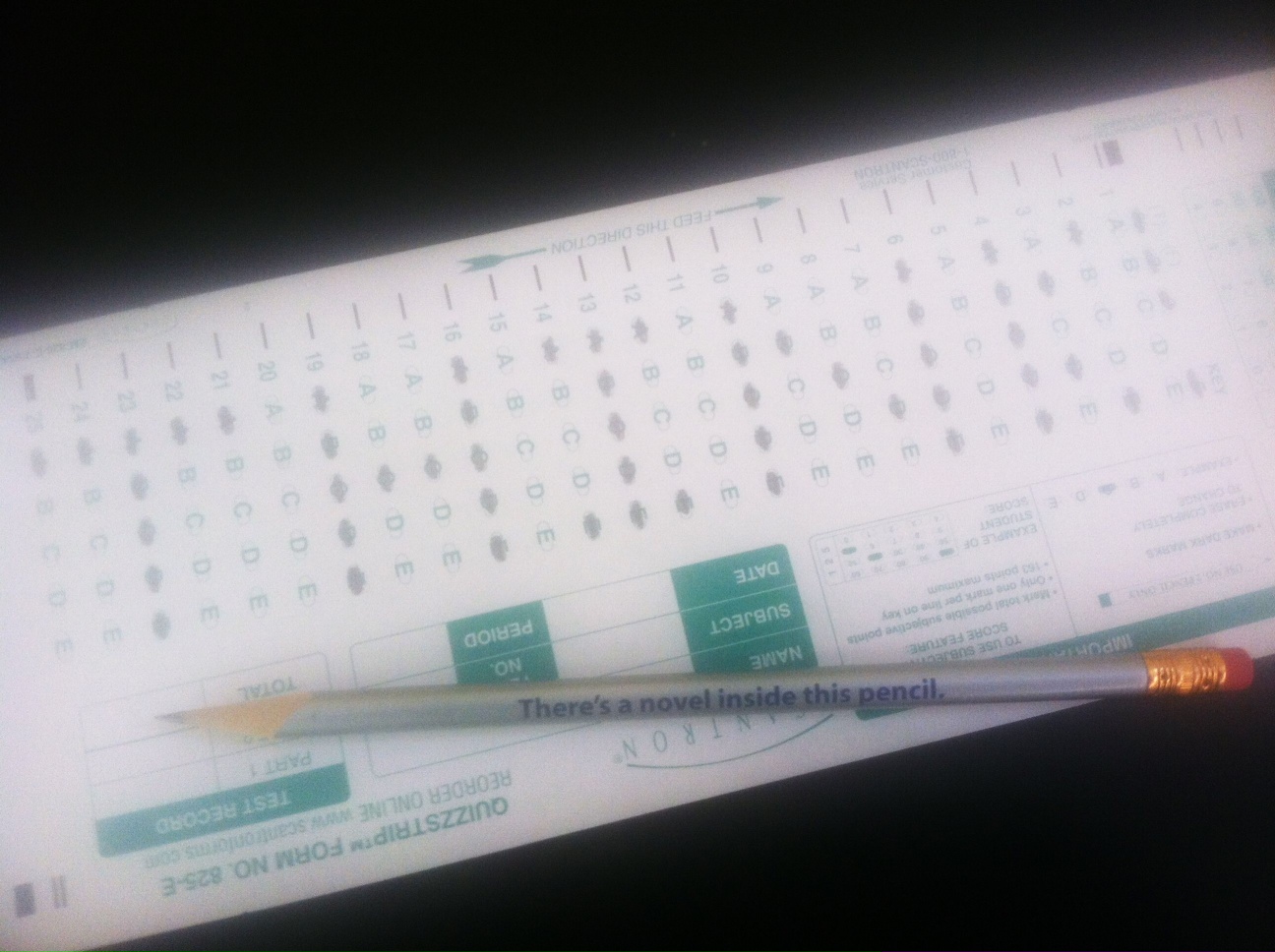

Writing is the artifact of thought. Even thought about something that's not important to me is my thought, a product of my mind, something that can't be blamed on anyone else or credited to anyone else. For that reason, all writing is personal. All writing comes from the individual, is a reflection of the individual. It's not the choice of someone else's best answer; it's the assertion of my own best answer.

And so when I respond to my students, I want to say more than good or bad. I want to make a note of what moved me about the writing (and sometimes I have to really search for it), and I want to offer counsel regarding those places where more work could be done, where the student can make it even better (even if by even better I really mean: well enough that I don't feel like my brain is crawling out of my skull in protest, which is really what I mean at times).

Because I don't want them to hate writing. I don't want them to quit writing. Writing is important. Even if it's not writing anymore. Even if it's emailing or tweeting or posting or some other derivative of the original act of composition, it's still the outward sign of an inward process that is extraordinarily vital not only to the individual but to the society that is dependent upon the individual's ability to create his own ideas.

This is my fear as a teacher. My fear is that education will continue to revolve around the notion that there is only one right answer and that right answer comes from someone else. My fear is that we will move farther and farther from giving students the opportunity to develop their own ideas, to construct their own knowledge, and closer and closer to a group mind that can only function when told how to function by the nearest authority figure.

Making learning personal is something that should be encouraged in schools, in every class, from the earliest grades forward. Making it about forging one's own personal ideas about the world and delivering those ideas to the world's doorstep - be it in the form of a blog, a painting, a brief but powerful tweet, or even in graffiti - is the only way to ensure that we never dwindle down to four choices, only one of which is right. 

Tuesday, March 26, 2013

Why it's important to teach kids to be horrible writers.


I've been persuading my students to participate alongside me during National Novel Writing Month for a few years now, and every year I hear a significant amount of moaning and groaning about the endeavor. Most recently, my students have been poor, helpless sixth graders, compelled against their wills to write between 1500 and 3000 words of fiction, with a proper story line and all. That's one of the things that crosses over from the writer part of me to the teacher part of me: god-like control over the fates of developing characters.

Here's what I hear the most:

I don't have any ideas.
I'm a terrible speller.
I'm bad at writing. 
I hate writing. Why do we have to do this?

This always strikes me as sad. For one thing, how can sixth graders not have ideas? I've never heard in my life more bizarrely interesting narratives than those shared amongst twelve years olds before class begins. They have ideas, but I think sometimes they protect them from teachers because rather often we spend more time correcting their grammar than acknowledging their thoughts.

I can't help but feel like the self-proclaimed lack of ideas is related to the belief that they're bad writers, and that the belief that they're bad writers is related to their views of spelling and grammar as hurdles to writing success. Sure. It's important that kids develop an understanding of correct spelling and conventional grammar, but those aren't the things that make great writing. Great writing comes from risk-taking. Great writing is a product of the unconventional. Some of the greatest writers have completely tossed aside grammar and spelling in favor of style and voice.

Comma splices can be fixed. But it's hard to repair a kid's belief that somehow his poor spelling translates to terrible ideas. That belief is crippling, not only to the child as a writer, but to the child as a thinker.

This is where I have to get back to fun in the classroom. I'm aware that every minute of every day can't be a trip to Disneyworld. I've even expressed that to my kids on occasion. But that doesn't mean that every day has to be terror-filled lest we forget to dot an i. It doesn't mean that we have to make every assignment a Geneva Convention violation that we pick to pieces until it's a bloody tattered flag of surrender that some kid throws up with the plea, "I can't help it. I'm a terrible writer."

Writing is hard work. Coming up with ideas is no walk in the park (unless walking in the park is how you come up with ideas). Published writers, writers who make money doing it, writers who seem to write without any self-doubt, struggle with writing, believe they're writing is terrible when they're in the midst of it. Chuck Wendig, one of my favorite writers, had a whole Twitter dialogue with Richard Kadrey about the insecurities that most, if not all, writers struggle with. If writing is hard to the best writers, those writers who've been encouraged, whose books have sold, who have evidence that people like them, they really like them, how much harder is it for kids who know that they're ideas are lying at the feet of someone whose job is to tear it apart in the hunt for errors?

This is why I love National Novel Writing Month. This is why I'm utterly committed to it despite the fact that on certain days, after I've read for the third time a tale of a vampire-loving werewolf, I want to gouge my eyes out. 

"Oh, Edward. How I love your sparkly skin."

When my kids start to freeze up, right from the outset, start to offer their defeated protests, I offer them this: I challenge you to write the most horrible story of all times. Create something truly godawful. Something that will make your parents consider committing you to an institution, that will make them utterly resent paying taxes to support the institution of public education. It's okay. I'm looking for the worst, most preposterous story ever written.

And out tumble some of the most original stories that I've ever read. Stories about talking chickens from outer space. Stories that feature me as a secret agent whose headquarters can be found in the bowels of a Kentucky Fried Chicken. Stories of parallel universes where everything is made of candy, teenage spy girls, lots and lots of zombie apocalypses. And, yes, stories of vampire-loving werewolves.

After two days, I can't get them to quit writing. They beg for time to read their stories out loud to one another. They read to an audience of their peers who also love talking chickens and zombies, and they're met with applause and laughter (the good kind). They start to think, "Well, I was trying to write the worst novel in the world, but it looks like I failed at that because these other people like my story." That's a failure that most people can live with.

Is the grammar terrible? God, yes. Can we fix it? Absofreakinglutely. Do we have to fix it right away? Do we have to focus on the spelling and grammar in the initial throes of world-creating excitement? No way. Forget it. 

Because here's the thing about writing. As with every skill, it only improves with practice, and people don't practice things that they hate doing. They practice things that they enjoy. If learning isn't fun, if we can't make writing enjoyable, especially in the early years of school, kids won't practice, and they won't get better at it. If they never have the opportunity to come up with their very own completely ridiculous ideas, with their sometimes godawful ideas, they won't get better at thinking either.