Wednesday, April 17, 2013

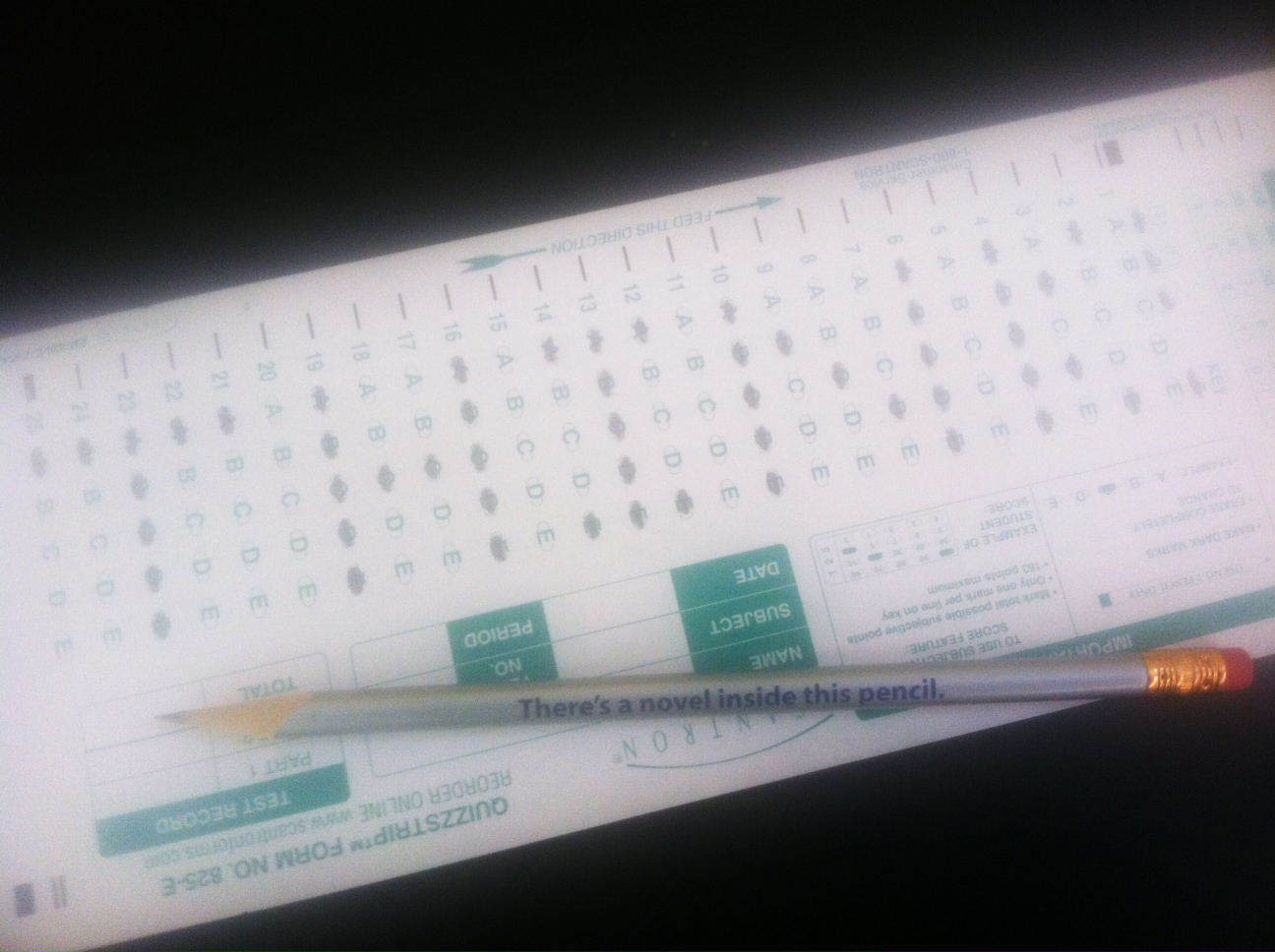
Three cheers for adequacy.

Photo by Terrapin Flyer
Years ago I sat in a staff meeting at a school which shall remain nameless, but which, I feel certain, was very similar to hundreds of other American schools, and I was struck by the excitement over achieving the greatest goal imaginable in public schools: making adequate yearly progress.

Yay. We're adequate. 

Since when did being adequate become something to strive for?

Yay. I'm good enough. Not great, really, but y'know, I'll do as long as there's no one more than adequate around.

For all the lip service given to 21st century skills in schools: collaboration, communication, creativity, innovation, problem-solving, critical thinking in addition to the old stand-bys, the educational system itself is not set up to encourage the mastery of those skills. It's not set up to achieve anything greater than adequacy. Standardized tests, the be all and end all of the educational system, as a general rule, don't necessitate any of the above skills. Some of the skills, in fact, are completely contrary to standardized tests.

Creativity and innovation, for instance, both require a learner to consider several possibilities that have never been considered before. That's the very essence of these skills: generating new possibilities. Problem-solving, likewise, requires the thinker to consider multiple ways to tackle difficult situations, acknowledging that there are several acceptable solutions to most problems, and that the best solution can vary from one circumstance to the next.

Such is not the case with standardized tests whose stems are written as such: Choose the best answer. (The best is generally italicized to draw attention to it.) Of course, best implies that there is more than one answer that could be correct, but only one is best. That best gives the illusion of choice, the illusion of problem-solving and critical thinking. Regardless of the phrasing, however, what the test-makers mean by best is simply...what your teacher would tell you...what you memorized (and will promptly forget after the test). 

The system, at times covertly and at other times aggressively, throws up obstacles to the very skills that are needed in the modern era. Efforts to turn around failing schools with innovative curriculum like the Quest Schools and the Turnaround Arts Initiative - programs that truly, unapologetically embrace the 21st century notion that our students need to be more than automatons, that they need to be independent, well-rounded thinkers - are thwarted by testing paranoia. Tests that don't even begin to measure the skills necessary to thrive in the world keep schools and students as well as teachers from achieving anything beyond adequacy by intimidating them, frustrating any attempts at positive transformation.

Until our educational policy-makers become more creative and innovative, until they communicate and collaborate with teachers and students to discover what is really needed to make classes places of authentic learning, until they recognize the problems in the traditional modes of instruction and think critically about how to solve those problems - in short, until our policy-makers become greater than adequate - we certainly can't expect much more from our schools.

Saturday, April 13, 2013

I: music for a character in a dark place


Because (despite my son's assurance that our house is "quiet, too quiet") my house is full of the sounds of Minecraft mood music, cats knocking porcelain things from high shelves, imaginary light saber battles, etc., I find that I often have to plug up my ears with music that will inspire writing rather than interfere with it. In a perfect world, I'd write in perfect silence, but as it is, I find one song that helps me to picture a scene or feel a mood, and I play it over and over until it becomes a suggestive silence of its own.

Andrew Byrd is perfect for that sort of thing, and his song I was a go to for me while working on sync in November. I was the song that helped me to experience my protagonist's sense of isolation and fear in his most trying moments.

In this scene, Charlie's been dropped into the House of Darkness, the Sumerian afterlife:

If Charlie had feared the consequences of such a long fall – he could not see a bottom to the pit – his fears were soon replaced with fears of a different sort. Around him, he heard the rustle of wings flapping against the blackness, and he felt a presence nearby that he couldn't see. In the next moment, his arms were seized by what felt like talons, biting into his flesh. Something large had captured him and was pulling him through the air, in what direction Charlie couldn't tell.

At some distance, Charlie could see a faint flickering of reddish hued lights, and a shiver went through him. He was approaching the House of Darkness. His eyes had somewhat adjusted to the gloom, and the trickle of light afforded him a view of the creature that had captured him. He looked up and saw that he was in the claws of a beast with the body of a lion and the filthy wings of some giant bird. The face, though, brought a cold chill to Charlie’s heart. It was the face of a man with glowing eyes and the sharp teeth of a vampire. The creature was intent on whatever path it was on and ignored Charlie, and Charlie was glad of it.

The lights of the House of Darkness did not grow brighter as they neared, but they did grow. As the assembly of the gods had been built of a white marble that seemed to stretch in all directions, the House of Darkness must have been built of infinitely dark matter. Though Charlie sensed a structure, it was invisible in the darkness. He felt the floor when the creature dropped him, but he couldn't see it, and so he seemed to walk through nothingness, and his body jerked repeatedly, instinctively, to catch him from falling.

Amber flames flickered here and there, and Charlie, drawing near to one, saw that there were souls or demons, he wasn’t sure which, trapped in these, gnashing their teeth at him when he came too close. He backed away towards what felt like the center of the space and continued walking through the great room of the house. He wasn’t sure where he was going, but he continued moving forward.

He wasn’t alone in the House of Darkness. He heard moans and whimpers, whispers and groans around him, and when he strained his eyes against the darkness, he vaguely saw the shapes of men and women who were covered in matted, gray feathers, some sitting, some lying prone, some pulling up clumps of dirt and shoving it towards their mouths ravenously, some scurrying about carrying baskets and earthenware bowls in the pitch blackness. He could make out hills and mountains rising in the murk, and upon close inspection, he saw that these were built from the relics of the inhabitants of the House of Darkness. One mountain was made entirely of crowns: gold, silver, platinum, tarnished, encrusted with jewels that did not sparkle or glitter in the darkness of the underworld, whose royal lights had been dimmed. Here, all men were the same, thought Charlie. No wonder Gilgamesh went in search of immortality.

Ahead, Charlie saw a conflagration of the amber orbs that cast just enough dim light to allow him to make out the rising of a great throne.

“This must be the place,” he said aloud, just to hear his own voice. In the utter darkness, he had begun to get the sense that somehow he didn’t exist. He felt bodiless, and therefore voiceless, and he wanted to reassure himself that such was not the case. It was an entirely different sensation than what he'd felt on the mountaintop. Then, that bodilessness had made him feel a part of all things, now it made him feel a part of no thing.

He drew near to the throne, which was constructed of an array of bones faintly glimmering with a golden hue under the orbs, and he could see the figure of a woman seated upon it. She had wings that grew from her back, enormous and black and widespread like a vulture sunning itself in the early morning. She wore a crown of gold-tinted bones tangled in her mass of black hair, and her feet were the feet of a great bird with long, pointed talons. Sitting at her feet, her legs crossed, was another woman who held a tablet of gleaming black stone and read from it to the Queen of the Netherworld.

The two raised their heads in unison when they saw Charlie approach, examining him the way that he had seen his mother examine cuts of meat at the grocery store.

Thursday, April 11, 2013

Why it's better to be worser


Years ago, I had the extraordinary good fortune to participate in one of NCCAT's enrichment seminars. It was awesome, and if I could ever persuade any North Carolina teacher to do anything, it would be DO THIS!!! 

The seminars are intended to reinvigorate teachers with a healthy dose of fun learning...you may be noticing a theme in my writing. Sometimes the seminars are specifically related to pedagogy. This season, for example, one offering is "Catching Up With Your Students: Navigating Technology for 21st Century Classrooms." Many of the seminars though are strictly pleasure-learning. Science aficionados might participate in "Climbing the Double Helix: Is DNA Destiny?" Teacher-writers might try out "Writing from Sound to Sea: Awakening Creativity by the Shore."

When I went, I participated in a seminar on Nature Writing and Watercolor Painting. The first part was a breeze for me. I love nature, and I love writing, so naturally, writing about nature was something that I'd already practiced on my own for years. When I first began the seminar, I wasn't too stressed about using watercolors either. After all, I'd taken art courses in high school, and I wasn't too bad at it. I like to consider myself a fairly artistic sort.

I remember that first session when the artist who was leading the workshop quickly dashed off a beautiful mountain landscape complete with fallen logs and winging crows. It looked simple enough, and I went back to my little table eager to get started. It's just a line here and a couple of splotches there, after all. Nothing too challenging.

After only a few moments I realized that my teacher had made the act look much simpler than it really was, and I could feel my frustration mounting as I fumbled with my brush, clumsily smearing black tree trunks and blobs of orange leaves that looked at best like a kinder-gardener's nightmare. I walked around the classroom to see how my peers were doing, envious of those who had quickly picked up the skill and reassured by the rest of the crew who were as sorry as I was.

By the end of the week, I was a little better. A little. But I'd learned a really valuable lesson that I took back with me to school. Sometimes teachers need to be worser to be better.

What I mean is this: sometimes, because we're so dang good at what we do, we forget that it's not easy for everybody else. We don't always respect the learning curves of our students. I've been guilty of it when teaching writing and technology. I've found myself growing impatient and thinking, "Gah! It's so easy! Just do xyz..."

When we get to that point in our careers, it's important to do something that we're not good at. This is why I've said before and will (I hope) continue to say: A teacher who refuses to learn should retire. Because if we push our students to stretch themselves, to risk failure, then we have to remember what it's like to stretch, to risk, and yes, to fail. If we stay in our comfort zones, it's easy to get so comfortable that we forget the anxiety of learning something new. 

A good teacher should be a dilettante, not just an expert in one field. Experts forget what it's like to struggle with understanding, they forget that they once had a learning curve. A good teacher should be really terrible at a lot of things and she should strive to improve in the face of frustration and embarrassment so that she is always capable of empathizing with her students.

Wednesday, April 10, 2013

Just say no to fun-suckers

Nicole Dodson, Dakota Jerome Solbakken and Nadine Clements, students at Quest to Learn, a New York City public school, play a game they designed.


Institutionalized prejudice against fun in the classroom works against students, teachers, and societal progress as a whole. A crippling bias in favor of traditional pedagogy, a stultifying notion that because classrooms were not fun in the past, they needn't be fun today has contributed not only to the low graduation rate in American schools but also to the low morale of educators themselves. 

Almost half of the students interviewed for the Bill and Melinda Gates Foundation study on high school dropouts claimed they dropped out because classes weren't interesting. According to an NEA report on teacher attrition, of the 46 percent of teachers who leave the profession after only five years, 56 percent cite job dissatisfaction as their reason for leaving. That dissatisfaction is directly tied to high-stakes testing, confused administration, and lack of support and respect. In short, teaching just ain't fun anymore.

Despite the fact that fun could be the savior of education, it's under fire from all sides. Innovative school ventures such as the Quest to Learn school in New York, create stimulating, exciting, rewarding experiences for students and teachers alike. Yet the same parents who fight to have students enrolled in the school, fight equally hard to ensure that the learning becomes increasingly more traditional so that students are prepared for standardized tests (which, if I haven't mentioned this before, prepare students for absolutely nothing in the real world). Meaning, even parents who want their kids involved in more creative, relevant learning, are too afraid of standardized tests to fully support innovation.

Likewise teachers, who would benefit from fun more than anyone aside from students, are often biased in favor of more traditional pedagogy, frowning at fun with the dour affect of a Victorian schoolmarm. They say things like: Fun might mean fun for kids, but it means work for teachers. Kids who are having fun in a classroom simply aren't learning. And, my personal favorite, fun classrooms don't prepare students for the real world.

True confession time. I have told kids, "Kids, this isn't Disneyworld. It's school. It's not supposed to be fun. You're supposed to learn." I admit it. I'm not proud. But in my defense, usually those non-exhortations were direct results of exhaustion from the hundred miserable and utterly meaningless tasks assigned by supervisors appointed at the government level who have never set foot in a classroom for more than five minutes, who have done everything in their power to suck the joy out of teaching and learning.

There have been times when I felt like I was smuggling fun into my classroom, looking over my shoulder to make sure no one was watching, as if that would somehow undermine my authority and credibility as a teacher. And I learned early in my career that as a general rule, fun as pedagogy should not be discussed openly as the very notion pisses a lot of people off, and it doesn't take long for the fun-suckers to start giving you the stink-eye if you're a proponent of such blackguard practices.

But here's what I've discovered over my years of teaching, short though they may be.

Fun is not more work for a teacher. Coming up with fun lesson plans is exactly the same amount of work as coming up with boring lesson plans. Implementing fun lessons is easier than implementing boring lessons. Kids enjoy it, and people commit to things they enjoy. When my kids are having fun while they're learning, they learn more and they don't fight me over it. I've had classes so fun that kids didn't even want to stop learning, and that's a score in my books.

Fun does not void learning. I'm much likelier to stick to something that I'm enjoying. I don't mind practicing something that's fun. And activities that are novel and interesting stick in my mind longer than those that are dull to the point of brain freeze. Innovative educational practices such as Smallab, or "situated multimedia art learning lab," that allow students to learn in exciting, virtual environments, interacting with material rather than having material thrown at them via lecture, have proven already to bear great promise. In a small 2009 study, at-risk ninth graders in earth sciences scored "consistently and significantly higher on content-area tests" when they had participated in Smallab exercises than those who had been subjected solely to more traditional teaching methods.

Finally, there's no reason why the real world, the world of adulthood, has to be anything less than fun. In fact, we are uniquely positioned in history to create exactly the sort of real world that we desire. There are more start-up businesses today than ever before in American history, and that means that people are crafting careers for themselves, and I can almost guarantee that entrepreneurs are not designing futures of arduous anxiety. We're building the careers that we want to have, the lives that we want to lead. Schools should most definitely be preparing students for that future.

Wednesday, April 3, 2013

The two choices you get in life


Even though I rail against an educational system that depicts life as a series of multiple choice problems with very limited actual choices, in reality, there are always only two choices in life at any given moment - continue on as I am or choose something different. Either way - whether I choose the security of where I am or the uncertainty of where I might be - there are risks, I'm just ignoring them when I make one choice and acknowledging them when I make the other.

This seems to be a running theme for me lately, and for good reason. I'm about to change my whole life as well as my child's - getting married, moving to a new place, enrolling in a new school, finding a new job. While my status quo has included all the struggles that any single, working mother faces, the struggles have been predictable. Though I've missed the variety of New Orleans, the culture and the opportunities, I've grown accustomed to the quiet nights of a small town. I've had moments of loneliness, but I've gotten used to being alone.

Despite inherent monkey wrenches in the machine, I've carved out a safe, cozy little life, and now I'm leaving it behind in favor of an exciting unknown. There's a certain amount of trepidation in sacrificing the comfort of a dull familiarity, an often worrisome familiarity, even in favor of a promising unknown.

There was a moment, months ago, when I had to weigh those two choices - to stay or to go, to risk or to retreat - and make a decision. It was nerve-racking trying to imagine every possible scenario that might result from either choice, and of course, it's impossible. There was no doubt in my mind that I loved my fiance Jack and that we'd be happy, but it meant changing everything my kid and I know in one swift motion. Everything. A very patient friend, after months of listening to me worry over possible futures, finally said, "You don't get to know what will happen. You just have to decide."

Jack has said the same thing about my writing. I've always written just for myself because I enjoy it. I've written a novel a year since Fain was a baby, but they were always just an escape for me, a free vacation. Recently, as I've considered publishing, I've been gripped by fear. Writing for myself is safe; writing for publication is a risk. Jack consoled me in a moment of neurotic crisis by telling me that if I tried and failed, nothing would change anyway, so I may as well get on with it. (Poor man, he's taken the great risk of marrying a neurotic lunatic.)

If I don't choose the risk of the unknown - whether it's marrying, moving, or writing - then I may as well quit teaching. If I won't take risks myself, even if it's scary as hell, I've forfeited the right to ask my kids to take risks.

Tuesday, April 2, 2013

A sense of limitless possibilities


I've spent most of the day walking around New Orleans, re-exploring. Although North Carolina has been good to me during the past seven years, I did miss the sense of unexpected possibilities that I always had in New Orleans.

After walking around my small town in North Carolina a few times, I had memorized it. Once I became that familiar with it, I started to forget what it was like to be surprised and excited by constant newness. I think in a way, it also limited my sense of my own possibilities. Walking around today, peeking down streets, into shops, I got that sensation of expansiveness that I remembered from my time here before.

I remember my very first night in New Orleans. I was twenty four, and I arrived at the hostel where I'd managed to get a job just as the daytime sky was fading into a gray blue evening. I remember standing outside the old house on Prytania breathing in the air. It had that thick, sweet nighttime in the South smell that I'd never noticed anywhere else before. I recognize it in other places now, but it always makes me feel as if I'm standing back in New Orleans on that first night. I imagine it's the smell of old oaks and palms and jasmine breathing out a sigh of  relief with the setting of the sun.

I was overwhelmed with excitement back then. I'd always wanted to visit the city, but I never imagined that I might live there. I'd grown up in a small town with a strong sense of expectation and duty. Striking out into the world alone hadn't been among my plans, and it was just a strange caprice that prompted me to pack everything up and leave what wouldn't be packed up behind. Standing there then, I was still surprised by what I'd done. I was still a little dizzy with a sense of the unreality of it.

That was probably what made New Orleans so special to me. My snap decision to break out of the limits that I imagined for myself seemed bound up with the city so that I attributed to it a surreal magical quality that continues to color my view of it. I get the same thrill now when I strike out on a long walk here that I got those fourteen years ago. That I'm on an adventure. That anything is possible. That I might still surprise even myself.

Thursday, March 28, 2013

The infinite possibilities of seven billion brains with one hundred billion neurons a piece


One of the hardest parts of teaching writing is giving feedback. It can take days to accomplish this feat. By the time the stories my sixth graders write are completed and ready to be reviewed, I've already read them several times in order to give encouragement or advice along the way, but I still struggle with feedback. When they compose, my kids have to sit and think, pull ideas from their own minds, commit to them, stand behind them, none of which are easy tasks, even for an old woman like myself. Consequently, when I judge my kids' writing, I know that I'm judging my kids. I want to be honest with them about what works and what doesn't, but I want to be gently honest. I want to be the sort of honest that prods them to improve, not the sort of honest that prompts them to give up on writing altogether. 

Because even if the writing is terrible (and sometimes it's beyond terrible and well into the realm of painful to read), it meant something to my kids. Even if the kid in question protested throughout the process, declaring that he wasn't even really trying, it meant something. And even if the kid defiantly ignores my counsel in favor of what he thinks is the best way to tell the story, I want to support that because I want my kids to have their own ideas, even if I think they're godawful ideas. 

No writing is impersonal. Even when I taught high school and my kids were writing research papers that they absolutely didn't care a thing about, it was personal. Unlike a math test, where the answer is objectively right or wrong, unlike standardized tests where there's only one "best answer" of four, writing is the articulation of the individual's mind, writing is the expression of the infinite possibilities of seven billion brains with one hundred billion neurons a piece firing off more choices, more best answers, than we can conceivably imagine or capture on any sort of test. 


Writing is the artifact of thought. Even thought about something that's not important to me is my thought, a product of my mind, something that can't be blamed on anyone else or credited to anyone else. For that reason, all writing is personal. All writing comes from the individual, is a reflection of the individual. It's not the choice of someone else's best answer; it's the assertion of my own best answer.

And so when I respond to my students, I want to say more than good or bad. I want to make a note of what moved me about the writing (and sometimes I have to really search for it), and I want to offer counsel regarding those places where more work could be done, where the student can make it even better (even if by even better I really mean: well enough that I don't feel like my brain is crawling out of my skull in protest, which is really what I mean at times).

Because I don't want them to hate writing. I don't want them to quit writing. Writing is important. Even if it's not writing anymore. Even if it's emailing or tweeting or posting or some other derivative of the original act of composition, it's still the outward sign of an inward process that is extraordinarily vital not only to the individual but to the society that is dependent upon the individual's ability to create his own ideas.

This is my fear as a teacher. My fear is that education will continue to revolve around the notion that there is only one right answer and that right answer comes from someone else. My fear is that we will move farther and farther from giving students the opportunity to develop their own ideas, to construct their own knowledge, and closer and closer to a group mind that can only function when told how to function by the nearest authority figure.

Making learning personal is something that should be encouraged in schools, in every class, from the earliest grades forward. Making it about forging one's own personal ideas about the world and delivering those ideas to the world's doorstep - be it in the form of a blog, a painting, a brief but powerful tweet, or even in graffiti - is the only way to ensure that we never dwindle down to four choices, only one of which is right.